
Scientific Translation with AI: How to Keep Numbers and Figures Exact
A scientific book is judged on what it states. A novel can survive a clumsy sentence; a textbook cannot survive a wrong value in a table, because the reader has no reason to doubt it and no way to check. That is what makes scientific translation with AI different from translating fiction. The prose is rarely the problem anymore. The numbers and the figures are.
This guide is for authors of non-fiction and for publishers of textbooks and scientific works who are translating with AI, or thinking about it. It covers where errors hide, why the usual ways of checking a translation miss them, and what a check that cannot be fooled looks like.
Where AI Translation of Scientific Text Goes Wrong
Non-fiction is where AI translation is strongest. Its sentences carry information rather than voice, and a modern model renders them accurately and naturally. On a book-length text, though, a few failure modes show up at least once: a model can hallucinate content that is not in the original, summarize a passage instead of translating it, or quietly shorten a section. In a scientific text each of these does more damage than in a story, since a dropped sentence might be the one that states a limitation of the result.
These are the failures a reader of the translation cannot see. A garbled sentence announces itself. A paragraph that lost its last caveat reads perfectly well.
Numbers, Units and Names Need Their Own Check
Most of what a scientific reader takes away from a page is a short list of facts: a value, a range, a unit, a direction of change, the name of a compound or a place. A translation can keep every word in the right register and still change one of them. "At least 40%" becomes "40%". "Rose" becomes "fell". "Per 100 adults" disappears.
When we translate the text of a figure, a separate check compares each translated text with its original for exactly these facts: numbers and ranges, names, directions, negations and qualifiers such as "about" or "only". It ignores style entirely. A text where it finds a changed fact is translated again, with the change pointed out. Numbers, units and symbols themselves are never translated at all: on a figure, 1,234.5 stays 1,234.5 and 200 g stays 200 g, because a reformatted number is one more thing someone has to verify.
Figures Change Without Leaving a Trace
Charts, tables and diagrams are slow to translate because their text sits inside a picture. Image models can now redraw a figure with its text in another language, and the result can look like the work of the original designer.
An image model does not edit the labels of a chart, though. It draws the whole chart again, the bars and points along with the words, and nothing in the process forces a bar to keep its height. The result looks right because looking right is what the model is good at.
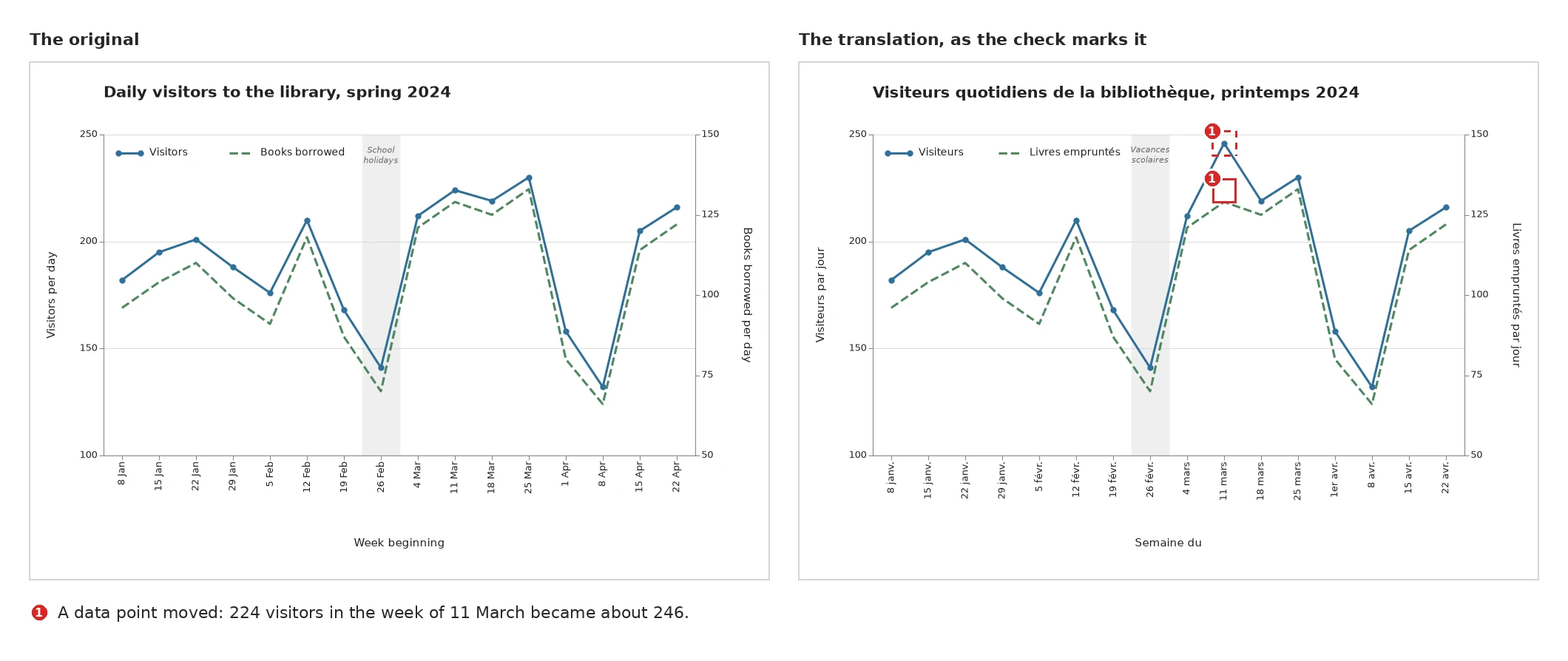
The pair of charts at the top of this page shows the kind of change that slips through. We drew it and the examples below ourselves, from made-up data, to show the mistakes an image model makes and what our check marks on them.
The French chart is well translated. Every title and axis label is right, the legend is right, the dates follow French conventions. The visitor count for the week of 11 March has also gone from 224 to about 246, and no word on the chart gives that away. A reader comparing the two by eye would have to notice that one point out of sixteen is a few pixels higher.
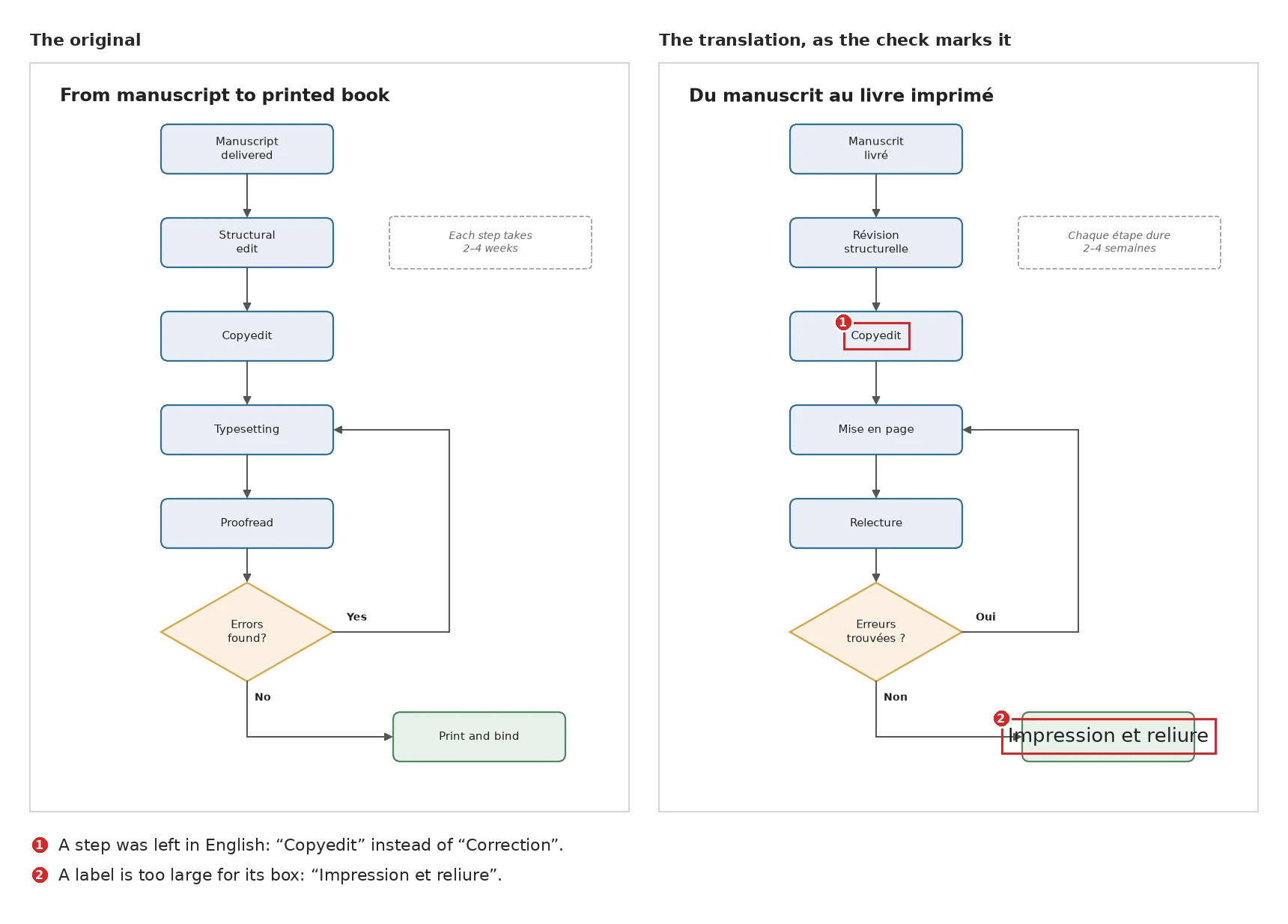
Text inside figures fails in quieter ways too. A step of a flowchart can keep its English name, or a translated label can come out too large for its box:
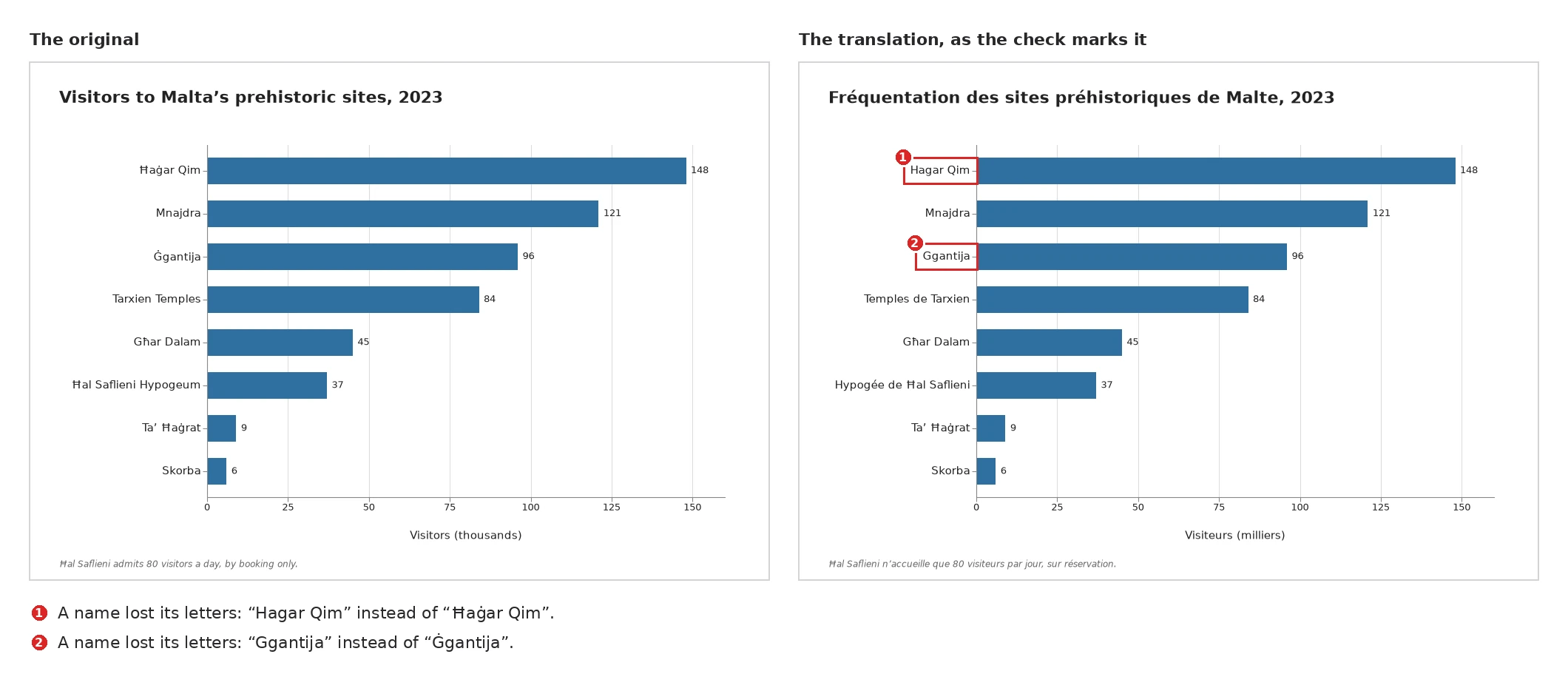
And names in less common scripts lose their letters. An image model can drop the dotted ġ and the barred ħ of Maltese, which turns a site name into one that no index or database will find:
Some scripts fail outright. In our tests, an image model wrote Hebrew words with their letters in reverse order on half its pictures, which is why we do not draw Hebrew figures yet.
Why Asking a Second AI Is Not Enough
The obvious fix is to show the original and the translated figure to another AI model and ask whether anything changed. It helps with text. It does not settle the data.
A model asked to compare two charts reads them the way a person skimming would, and it can miss exactly what the first model got wrong: a point that moved a few pixels looks like the same point. It also answers differently from one run to the next, so a figure it passed today might fail tomorrow. For a novel, a reviewer that catches most problems most of the time is useful. For a figure in a textbook, a check that might wave a changed value through is not a check.
Translators have long verified meaning with back translation: translating the finished text back into the original language and comparing the two. It catches a reversed comparison or a dropped negation in prose. It has nothing to say about the height of a bar: the data of a chart is drawn, and translating it back only reads its words.
What a Deterministic Check Measures
A deterministic check is one that gives the same verdict every time it sees the same picture, because it measures rather than judges. Ours holds every translated figure to three things:
- The text. The translated picture is read back and compared with the translation that was approved, so a missing text, a misspelling, a word left in the original language or a text that overflows its box is reported. A suspected misspelling is confirmed by a second, close-up reading of just those words before it counts.
- The numbers. Every number on the translated picture must match the number written on the original, and no number may appear that was not there.
- The data marks. Every bar, point, line, slice and axis of the translated chart is measured against the original. A mark that moved, changed size, disappeared or appeared is reported with where it was and where it went, and so is a color that changed.
The first part uses a model to read; the last two are measurements. When the check finds a problem, the figure is corrected or drawn again with the problem pointed out. If a problem remains, the picture is still delivered, with each finding boxed and named on it, so the person responsible for the book can judge it in a few seconds instead of comparing two charts line by line.
A box that only holds text, such as a legend, may grow to fit a longer translation. A data mark may not move at all.
A Workflow for Translating a Textbook or Scientific Book
The prose and the figures of a scientific book are two different jobs, and they are best handled separately.
Translate the text with the whole book in view. Terminology has to hold from the first chapter to the last, so the translation should be built from a guide to the book's terms, names and conventions rather than translated in disconnected chunks. Our comparison of AI and human book translation covers how that works and what it costs: a one-time fee per book, where a traditional translation of a 200 to 300 page book costs $7,000 to $15,000.
Keep the layout if the book has one. Textbooks are laid out with care, often in InDesign. One K-12 educational publisher moved to translating their IDML files directly and reports that their whole translation operation now takes about 20 to 25% of the effort it used to, with typesetting a 500-page book down from roughly two weeks to about two days. Their case study describes the workflow.
Translate the figures with a check, and look at what it flags. Whether a designer redraws your charts or an image model does, compare each one against its original before it goes to print. You can try this on your own figures with our free chart translator: upload a chart, a table or a diagram, correct its translated text, and get the picture redrawn and checked, with anything that changed marked on it.
Keep a person in the loop for the facts. A native-speaking expert reading the translated book remains the best final check on terminology and meaning. The checks above do not replace that reader. They make sure that what reaches them has the same numbers as the original.
Try It on Your Own Chart
If you have a chart, a table or a diagram to translate, the chart translator is free and needs no account. For the full book, upload it to see a free preview of the translation before you pay anything.
FAQ
Can AI translate scientific texts accurately?
AI translates non-fiction, scientific prose included, to a high standard, and the result reads well. What still needs care is the part a reader cannot verify: numbers, units, names and the data drawn in figures. Those need checks that compare the translation with the original, rather than a read-through that judges whether it sounds right.
Can an AI image model change the data on a chart it translates?
Yes. An image model that puts a chart into another language redraws the whole picture, bars and points included, and a bar can grow or a point can move while the chart still looks right. The only reliable way to know is to measure the translated chart against the original.
What is back translation?
Back translation means translating a finished translation back into the original language, then comparing that version with the original to find meaning that was lost or changed. It works on text. It does not work on the drawing of a chart, where the data lives in the position and size of each mark.
How do you check that a translated chart still shows the same data?
Compare it with the original by measurement: the position and size of every bar, point and line, and every number printed on it. Translate A Book's free chart translator does this for every chart it translates, and marks anything that moved or changed on the picture.
Can I translate the charts in my book for free?
You can translate charts, tables and diagrams one at a time with the free chart translator, with no account. It redraws each one in the new language and checks it against the original.