
How a Textbook Publisher Used translateabook.com to Divide Their Translation Time by Four
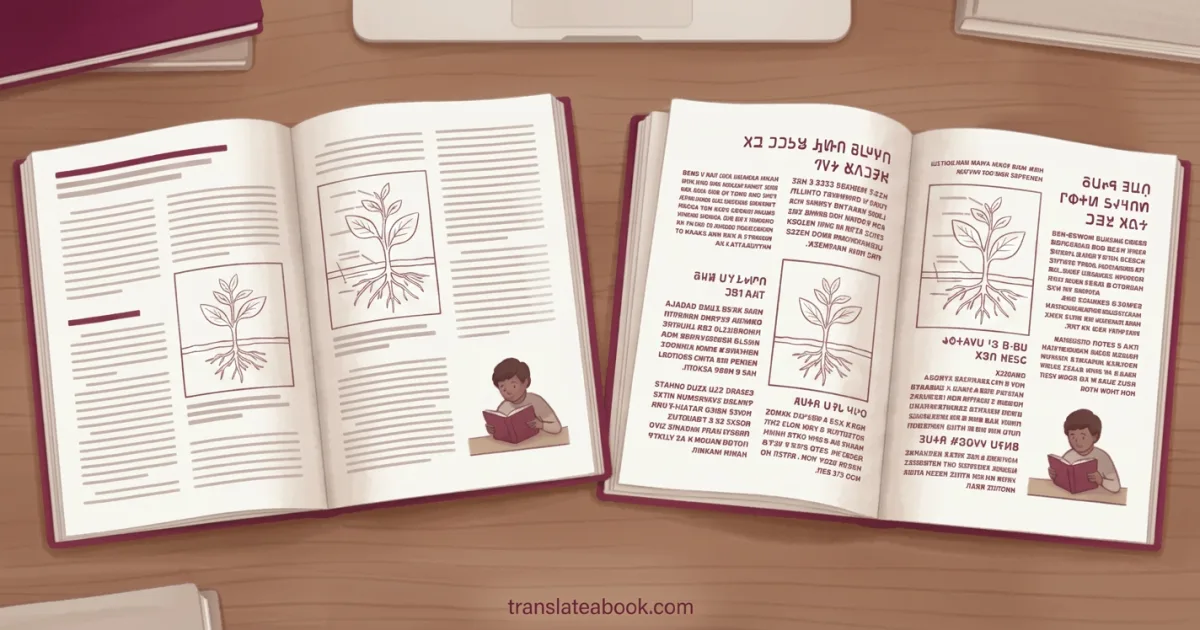
One of our customers is a school textbook publisher in the United States with 20 year experience. They've done more then 150 translations through translateabook.com - while they'll remain anonymous in this Case Study, they love the service and were happy to share how they're using it to divide their time to get a translation ready by four, and cut costs in more than half.
Key takeaways:
- Using translateabook.com, time to get a translation ready was divided by four, from about 4 weeks to a little more than a week.
- Total cost (including translation, typesetting and proofreading) was divided roughly by two, from $1500-$2000 to ~$700
- Their best linguist stopped translating and started editing, moving from two weeks per book to one, at lower cost, because editing an already good translation is cheaper and faster than translating.
- translateabook.com's translation often had almost no errors, and are good enough they can confidently send them directly to the states as a first draft, removing the human editing as a bottleneck and allowing them to reply to state adoptions even faster.
"The whole translation operation dropped to about 20 to 25 percent of its former effort", said the production director. "We are very happy with the service."
Context on the business
Having a translated version is a requirement for publishers answering state calls for textbooks. When a state runs an adoption (which is how requests for proposal are called), it approves the English textbooks against its standards, and then it wants to see them in Spanish before districts will buy them. In the US, this means Latin American Spanish specifically, which is a different job from the European Spanish most tools default to.
The publisher in this case study has been working with US states for about twenty years. They have around three full-time staff, and a network of contractors and practising educators writing and producing K-12 titles in math, science, and career and technical education. The person we spoke with runs production: overseeing translation and getting books typeset, laid out, and out the door.
They have decades of experience and tried many different AI translation tool before settling on translateabook.com to run more than 150 translations, and counting.
The old way: copying Spanish over the English layout
Before using translateabook.com, here was what the workflow looked like: an outside translator delivered the Spanish as a PDF, or sometimes a Word file. Then the team rebuilt the book by hand, copying and pasting the translated text over the English layout directly in InDesign and reflowing every page so it fit again. For a 500-page title it took about two weeks to translate and another two weeks to typeset.
Two problems rode along with that workflow. The first was quality. For a long time, outside Spanish translators were inconsistent, and the state sometimes rejected the result, which meant more edit rounds and more delay. They eventually found one genuinely good linguist, but a single person could not translate everything inside the timelines an adoption runs on.
The second problem was the (tedious) time it took to copy-paste from the human translator's document back into InDesign. Layout of textbooks are complex and matter a lot, so this was both important and quite slow, limiting the number of new books they could send to the states at any given time.
Why they chose translateabook.com
When the production director went looking for tools, most options fell at the first hurdle. "We couldn't find Latin American Spanish, only Spanish," he said. "There's a significant difference." The general tools of a year ago, in his experience, were not good enough on quality either.
translateabook.com cleared the language and quality bars: it reliably produced Latin American Spanish, and of much higher quality than other tools they tried before.
And very importantly, it translated IDML, the format InDesign exports, directly - which almost no other tool supports. Given their books had complex layouts this was a game changer: instead of retyping a translation over the layout, they could translate the file itself and get the same file back in Spanish. "It's hugely quicker than having to retype everything into InDesign again," the director said. On native InDesign translation specifically, his read of the market was blunt: "Nobody else is doing it."
The new workflow
The process now mostly runs without leaving their own hands. They merge a set of InDesign chapters into a smaller number of files, export IDML, and run those through the tool. The Spanish IDML comes back, they reimport it into InDesign, and they fix the handful of errors that surface on import, usually some boxes that are now too small for the translated text (since Spanish and English have different lengths). Then the file goes to their approved linguist, who no longer translates but edits, for a light final pass.
Because the base translation is strong, this linguist became an editor rather than a translator. Editing costs less than translating and goes faster, so the same person now clears far more books. As the production director put it, "If they were taking two weeks to translate a book, they'll now take a week to edit it." And the editor's own read on the output: "She doesn't find much. So it's good news."
Because they had bad experiences with previous translators, being able to multiply the quantity of books that can be handled by this linguist they trust is a big win.
Detailed costs and timelines
The publisher was specific about the change, and the figures are worth stating plainly.
| Metric | Before | After |
|---|---|---|
| Whole translation operation | 100% of the effort | about 20 to 25% |
| Typeset a 500-page book | ~2 weeks | ~2 days |
| The linguist's role | translate a book in ~2 weeks | edit it in ~1 week |
| Linguist fees (500-page book) | ~$1,000 (translation, ~$2/page) | ~$500 (editing, ~$1/page) |
| Typesetting (500-page book) | ~$500 (~2 weeks, ~$1/page if done externally) | ~$100 (in house in ~2 days, price estimate) |
| translateabook.com | not used | ~$150 |
| All-in cost per book | ~$1,500, ~4 weeks | ~$750, ~1 week |
"What we do now with your tool probably takes us 20 to 25 percent of what it took us before," he said. On typesetting: "Where it was taking us maybe two weeks to typeset, it's now probably only taking us two days." The tool itself he described as "an awful lot cheaper" than paying a translator by the page; in their case it came to about $150-200 per book.
All included, and if we estimate the time they spend typesetting internally at market rate, the whole process falls from a rough $1,500 before (about $1,000 to translate, $500 to typeset) to around $750 now (about $500 to edit, a little for the in-house typesetting, and roughly $150 for translateabook.com's translation).
Shipping a review copy before the edit is finished
An interesting consequence of having a quality AI translation was the unlocking of a new workflow that uses temporary copies, compressing the time to get approval from the states even further.
The flow is as follows: once a state approves the English edition, districts across that state review the programs. That review used to wait on the human Spanish edit. Now the publisher ships the AI translation as a temporary review copy first, then swaps in the edited version once their editor is done.
"We were confident that we could actually just typeset and complete the translation that you sent to us, put live as a temporary review copy, before she even went through and finalized her edits," he said. Reviewers accept it because the base quality is high and the English edition has already passed, so it's possible for them to start reviewing. The single-editor bottleneck comes off the critical path, and books reach reviewers weeks earlier.
The work that remains
For professional publication, humans are still in the loop, though the remaining work is greatly reduced and made more pleasant.
Regarding layout, languages take different amounts of space, so when the Spanish runs longer than the English, some boxes with fixed dimensions can overflow on IDML reimport. That is the cleanup pass in InDesign: resize or nudge a few elements. It is quick once you are used to it, and it is a fraction of time that was required to rebuild every spread.
The human edit still earns its place too. The publisher keeps a native-speaker editor in the loop as best practice, even as they lean on the temporary-review-copy approach to move faster. The edit doesn't disappear, instead it gets much smaller, cheaper, and stops being the bottleneck.
What this means for other publishers
The pattern here generalizes to most publishing companies. If you produce laid-out books in InDesign and translate them for another market, the layout rebuild is often as expensive as the translation, and it is very tedious work. Translating the IDML directly removes most of that. The translation cost drops dramatically, the layout cost mostly vanishes, and your best linguist shifts to the higher-value editing work instead of translating every single word.
For this publisher the sum of those changes was straightforward. "It's been a great experience for us," the production director said. The books reach reviewers faster, cost less to produce, and the small team spends its time on judgment rather than copy-paste.
FAQ
Can you translate an InDesign textbook without rebuilding the layout?
Yes. When the book is translated natively through its IDML export, the translation is written into a copy of your original file rather than rebuilt in another format. You reimport the IDML into InDesign and fix the few boxes where the translated text no longer fits, instead of copy-pasting a translation over every spread by hand.
Does the translation support Latin American Spanish, not just European Spanish?
Yes, and for the US school market that distinction matters. This publisher moved to translateabook.com specifically because it produced Latin American Spanish, which the general tools they tried did not offer at usable quality.
How much faster is native IDML translation for a textbook publisher?
For this publisher the whole operation dropped to roughly 20 to 25 percent of the effort it took before. Typesetting a 500-page book fell from about two weeks to about two days, and their linguist moved from translating a book in two weeks to editing it in one.
Is the AI translation good enough to put in front of reviewers?
This publisher was confident enough to ship the AI translation as a temporary review copy to state and district reviewers before their editor finalized the human pass, then swap in the edited version. They still run a light native-speaker edit as best practice, and the editor now finds little to change.